Showing posts with label teaching green. Show all posts

Happy Birthday Earth Day and Green Up Day!


Happy Earth Day!! Not only is today is the 40th anniversary of Earth Day, it's also the 40th anniversary of Green Up Day in Vermont. Green Up Day takes place on the first Saturday in May across the state of Vermont. Kids and adults alike gather in their communities to clean up liter. If you have ever visited Vermont, you will notice right away the impact this one day of action has. Not only do the roads, sidewalks, streams and trails get a facelift, but new generations learn the importance of keeping our environment clean. As a kid, I participated in Green Up Day with my classmates every year. I learned the importance not only of putting trash in the garbage can, but also the how important it is to recycle and to reduce the amount of trash we create. While scanning the ground, bushes and ravines for trash, I began to notice how our garbage impacts the habitats of small creatures in my community. Suddenly one day of action turned into a year-long effort to reduce trash, recycle and protect the natural habitats in my town.

If you live in Vermont, you can participate in Green Up Day on Saturday, May 1st. If you live elsewhere in the country or world, why not start your own Green Up Day? All you have to do is gather a friend or two, a parent or teacher and get greening!

Eco Boys and Girls Earth Day event!

With Earth Day right around the corner, there are plenty of great opportunities to get involved and learn more about the protecting the environment. On Saturday April 24th there will be a great event at the Liberty Science Center in Jersey City, NJ that you might want to check out if you are in the area. Fashion designer, former model, artist and Eco-Pioneer Maria Snyder will be introducing her latest project, Eco Boys and GirlsTM with a two hour fun filled adventure and scavenger hunt for children. The event will introduce the children to Ernie Earth©, Lulu Love©, Patsy Peace©, Ray Recycle© and Sammy Sun© who will bring messages of love, peace and environmental awareness. To learn more, click here.

Wisdom of the Wild


Anybody that has ever had a pet understands that there is a sacred bond between human beings and animals. Although we may think of ourselves as the most intelligent creatures on Earth, there is much we can learn from from the animal kingdom. Wisdom of the Wild is a terrific PBS documentary that sheds some light on our remarkable connection with our fellow creatures, including what they can teach us about the world, and about ourselves.

Click here to view the full documentary: Video: Full Episode - Wisdom of the Wild | Nature

The living reef...Here today, gone tomorrow?


Coral reefs are home to the greatest diversity of life on Earth. They protect our shores, contribute to our food chain, and provide us with medicines to keep us alive and healthy. Despite how important the coral reefs are to life on Earth, they maybe gone in less than 30 years due to global warming, over fishing, and the acidification of the oceans.

The reefs need your help! Read NOAA's 25 Things You Can Do to learn how you can help the reef.

Homemade Holidays


I am blogging over at Audubon.com's great blog, The Perch, today. Hop on over and get inspired to be crafty and green for the holidays.

"Creating homemade decorations was my favorite holiday activity growing up. Coming up with new ways to make gift wrap, gift tags, and ornaments from things found around the house and neighborhood was part of the challenge--and the fun. With being green on many of our minds this holiday season, we have an even greater reason to be resourceful and to look to nature for inspiration." Read more...

Ottawa's Greening With Green Bins


I have always been proud that my neighborhood of Park Slope Brooklyn, is considered the greenest neighborhood in New York City. But one thing it lacks, and all of NYC in general, is municipal composting. Many cities across the country and world have starting composting city wide. Compost is picked up along with the regular trash by the city. Composting is a powerful tool in fighting global warming, as it prevents the creation of methane in landfills. Methane is a greenhouse gas that is 21 times more potent than CO2 and is responsible for almost half the global warming impacting our climate today. Click here to read about more ways you can prevent methane from hurting the planet and here to learn more about composting.

When I learned that Ottowa, Canada is launching a municipal composting this winter, I have to admit, I was jealous! The city is handing out green bins for composting organic matter. Not only are they doing a great thing to reduce trash, prevent methane, and create wonderful nutrient rich soil, they are also trying to make it fun for residents to learn about how to compost correctly. Take the Green Bin challenge and see how you score against other composters in this fun game. Then learn how to make a liner for your recycling bin out of old newspapers!

NYC School Recycling Workshop

The United Federation of Teachers will be holding a school recycling workshop this Monday, November 23rd at 5pm at the UFT headquarters, 52 Broadway, New York. Register here, it's free!

Going Green Short Animations for Kids


Planet Green has a series of short animations with great messages about going green called My Place. They are silly, effective and fun to watch!

Going Green with Kids: Top Ten Green Activities and Projects


Here are some of my top 10 favorite green activities and projects I have written about over the years. Have fun!

Club Green: Starting an Environmental Club
Recipes from the Garden: Delicious recipes from veggies grown right in your backyard
Bug Off, Bugs!: Concocting your very own non-toxic bug spray for plants
Container Gardening: Planting a mini garden
Grow Your Garden: Designing your very own garden
Dirt Glorious Dirt: Composting 101
The Nature Journal: Creating a nature journal from recycle materials
Green Cleaners: The real dirt on cleaning products and how to make your own non toxic versions
Backyard Habitat: Creating a welcoming home for the creatures in your area

Rachel Carson - Brave Advocate for the Environment


“If I had influence with the good fairy who is supposed to preside over the christening of all children, I should ask that her gift to each child in the world be a sense of wonder so indestructible that it would last throughout life.” -Rachel Carson

Rachel Carson, (1907-1964) was a writer, a scientist, an ecologist and a brave advocate for the environment. As a young girl, Rachel’s mother nurtured her daughter’s love of nature. She studied the sea, plants and wildlife, and taught others about the living world around them through her books and articles. As a young woman, she became the Editor-in-Chief of all publications for the U.S. Fish and Wildlife Service, where she wrote pamphlets on natural resources and conservation. Carson strongly believed that people are integrally linked with nature, and must learn to care for it, rather than overpower it. One article she wrote, “Help Your Child to Wonder,” (1956) aimed to teach people about the wonder and beauty of the living world.

In 1962, Carson published the book SILENT SPRING, and with it the environmental movement was born. The book was written to raise awareness of the great harm that synthetic chemical pesticides had on the environment. It took great courage for Carson to speak out against the agriculture and chemical industries. But she firmly believed that we as human beings are just as vulnerable to the toxic pesticides we spray on our fields, homes and trees as the insects themselves are. In defending her book, Rachel Carson stated: “We still talk in terms of conquest. We still haven’t become mature enough to think of ourselves as only a tiny part of a vast and incredible universe. Man’s attitude toward nature is today critically important simply because we have now acquired a fateful power to alter and destroy nature.”

Big Ideas for a Small Planet


Did you know that there are dogs working to save wildlife? Watch the video to find out how, and visit Sundance Channel's The Green to see what other amazing things people, and animals, are doing to protect the planet.

Nature Detective


Hey Kids!

Did you know that we share our homes and yards with many creatures…other than your little brother? From tiny spiders to foxes, creatures live all around us, even if we can’t always see them. Sometimes we just have to use our sleuthing skills to find the evidence.

Can you spy any of these signs of wildlife?

-A nest

-A feather

-A spiderweb

-A nibbled leaf

-A shed exoskeleton

-Animal tracks in the snow, dirt or sand

-A burrow entrance

And now, try to spy the things a creatures needs to survive:

-Nuts, seeds and berries

-Pollen for bees

-Tall grasses, brush and trees to hide and nest in

-A source of water

With the evidence you find, can you make up a story about one specific creature’s day?

This post originally appeared on the Little Green Blog.

10 little things...

The Audubon Society has composed a great list called "10 Things You Might Not Know About The Food You Eat." To see more 10 Things lists, visit Audubon.org.
  1. The average fruit or vegetable we eat has traveled 1,500 miles to reach the table.
  2. About 40% of our fruit is imported from outside the United States.
  3. The vast majority - around 80 percent - of the energy used by the food industry goes toprocessing, packaging, transporting, storing, and preparing food.
  4. Domestic food transport creates 120 million tonsof CO2 emissions annually.
  5. Fresh peas can be produced with only 40% of the energy required for frozen peas.
  6. Children who eat conventional diets are shown to have six times the amount of pesticides in their bodies as children who eat organic diets.
  7. The world's fish species, more than 70% of which are overfished, could be replenished throughsustainable seafood management.
  8. Many farms offer weekly or monthly subscription baskets of fresh produce, flowers, fruits, eggs, meat, milk and other locally-grown and organic products.
  9. New York City's venerable Greenmarket helps preserve over 30,000 acres of working farmland.
  10. Organic crops contain significantly higher levels of vitamin C, iron, magnesium and phosphorous than conventional fruits and vegetables.

Here Comes Science! An interview with John Flansburgh of They Might Be Giants


It isn't often that kids and adults can agree on music. Your parent's might have been thinking less about making you happy and more about their own sanity when they bought you your very own ipod. But alas, there is hope! Parents, kids and especially teachers will all agree that They Might Be Giants' new cd/dvd Here Comes Science is totally awesome. You won't be able to resist tapping your feet and singing along to songs like "Photosynthesis" and "Roy G. Biv". And the great animations make it impossible to ignore all the fascinating facts about science coming your way. Eco-minded kids and parents will especially like the song "Electric Car". See video below (...isn't it amazing how many animals you can fit into one electric car?!?)

John Flansburgh of They Might Be Giants was nice enough to answer some questions about their new release.

Green Guide for Kids: Did you like science when you were a kid?

John Flansburgh: Neither John nor I were good students, but we were curious about the world. Books like "How Things Work" and pop science television shows were fascinating to me as a kid, just as Mythbusters is to me now actually!--just understanding the real systems and phenomenon within nature and technology.

GGFK: In the DVD, you make being a Paleontologist seem so cool. If you weren't a musician, would you like to be a scientist?

JF: Even if I wasn't a musician I don't know if any of us have the patience or focus to be scientists! Danny put that song together, and his kids are pretty dinocentric and I think the song came out of that interest. The video for the song has gotten a little bit of criticism from actual paleontologist because it shows Danny working in what looks like an archeological site, where most paleontologists evidently do their research indoors.


GGFK: When I was listening to Here Comes Science, I learned so many amazing facts. For example, one million Earths could fit inside the sun. What's the most amazing thing you learned while making this CD?

JF: That living things are mostly made up of just four elements!

GGFK: My favorite song on the CD is Electric Car. Do you drive an electric car?

JF: My most recent car purchase was an impossibly old Ford pick up truck for hauling logs around in the Catskill Mountains. but maybe that counts just on the recycling side of things! I don't think there are any fully electric cars on the market, although every day there is another tantalizing miniature electric car prototype in the news. It would be very exciting to see them take over New York City. A couple of friends of mine have hybrids and I have to say driving in near silence is pretty cool. It just seems so much smarter in the engineering than gas cars. But while the song is kind of an idealized dream of a world of electric cars, I feel a little nervous that it's message might inadvertently end up feeding shortsightedness on our national--or really worldwide--environmental challenges. It's simply not a given that electric cars for the moment won't just shift much of the problem from one behavior to another. How we're going to fuel any vehicles of the future is a huge unanswered problem, and as a culture we urgently need to focus developing alternative energy sources. Personally I think it's important that people know there is no such thing as clean coal no matter what the ads on tv say. Okay. I'll step down from my soap box now.

GGFK: What are some things They Might Be Giants do to protect the environment?

JF: As I am on the road touring with the band is a harsh reminder that as a business we are so far away from being eco-role models. I've been able to make more progress when I'm back in New York. My wife and I actually can often eat entirely locally grown food as much when we're in the country, which isn't hard since there is so much local farming. I feel I'm just waking up to how to actually reduce my consumption in small doable ways, but it is a constant issue. Our friends got my wife and I into composting which is much less gross than I thought, and a great way to avoid creating landfill. I've completely flipped over to green cleaning products which is honestly ridiculously expensive, but I can't see ever going back. They smell way to good.

Hey Teachers!


Here's a great way to peak kid's awareness of the water cycle, and how it is linked to many environmental issues, by joining in with kids all over the world in conducting research. The Global Classroom Project (TGCP) is a collaboration of thousands of children from 15 countries around the world. Classrooms participate by monitoring, measuring and recording rainfall data. Registration is open for this project that lasts for one more week.

To learn more about the project and the water cycle visit tgcproject.org.

Take the waste free lunch challenge

kidskonserve
Kids Konserve is challenging schools and kids to go waste-free this upcoming school year. To help you achieve that goal they are offering Green Guide for Kids readers 15% off their products. They have many neat ways to keep your lunch cool, clean and waste-free, such as an insulated lunch made from 100% recycled water bottles, a nesting trio of stainless steel containers, and a no-sweat ice pack that fits perfectly in the bags.

To get 15% off enter the coupon code: greenguide. Valid until 9/30/09.

A new book about being a vegetarian


Ruby Roth's new children's book "That's Why We Don't Eat Animals" tackles some difficult questions and concerns about eating meat. If you or your child are considering becoming a vegetarian or vegan, this book will certainly help to persuade you. It covers some difficult topics without being gory or scary. Visit the book's website to learn more about the book, and the author!

John Muir - A Green Pioneer


“Everybody needs beauty as well as bread, places to play in and pray in, where nature may heal and give strength to body and soul.” –John Muir


John Muir (1838-1914), known as “the father of our national parks”, was America’s most famed naturalist and conservationist. As an explorer, he embarked on exciting wilderness adventures from Indiana all the way to Florida, among Alaska’s glaciers and throughout California’s Sierra Nevada. During his journeys he kept nature journals in which he wrote about the beauty he saw in nature. He drew detailed sketches of plants, animals, mountains and landscapes. He used these journals to compose letters, essays, articles and books that taught people, then and now, the importance of experiencing and protecting nature. His writing and activism inspired President Theodore Roosevelt’s bold conservation programs and lead to the creation of Yosemite, Sequoia, Mount Rainier, Petrified Forest and the Grand Canyon National Parks. In 1892, John Muir formed the Sierra Club and was the club’s very first president. The Sierra Club continues John Muir’s work today, teaching people about conserving our natural heritage and establishing new National Parks and a National Wilderness Preservation System.


Meet Tim Magner, Part 2


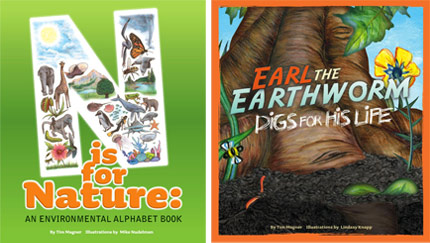
We are back with more questions for author Tim Magner, about two more of his books for young readers: N IS FOR NATURE: AN ENVIRONMENTAL ALPHABET BOOK and EARL THE EARTHWORM DIGS FOR HIS LIFE.

Both of these books aim to teach kids about many of the creatures we share our planet with, even the microscopic ones burrowing right under our feet! In your opinion, why is important that kids learn how other creatures live?

Since the beginning of human history, kids played outside. As part of every normal childhood, kids had plenty of time to wander, investigate and discover. Digging in the dirt and imitating animals gives them a chance to bond with the earth around us. Toddlers can identify with animals (especially young ones) and they grow into explorers who come to understand the connections and see us as a part of nature. Sometimes it's important to remember our roots.

EARL THE EARTHWORM DIGS FOR HIS LIFE teaches us about the amazing work of worms and how we can use them to create compost from our organic waste. Is this something that even city kids can do?

Our Earl story is entertaining in and of itself, but it's also about how, in nature, waste equals food. I love visiting schools and bringing some of my worms. Many of the city kids have never felt worms and can't believe I keep 1,000-plus of them in my kitchen. Vermi-composting is a way to explain nutrient flows and cycles. I'm a big proponent of the benefits of systems thinking over linear thinking and using nature as a model to help us move past the short-term thinking of the Industrial Revolution to a better future.

Your books really encourage kids to get outside and play. What was your favorite game to play outside when you were a kid?

We lived near a golf course and my brothers and I hunted for golf balls in the creeks and ponds. We came home well after sunset, covered in mud. Mom yelled at us. We also got to spend chunks of time in Wisconsin where we played with neighborhood kids, games like kick the can and flashlight tag. Good clean fun means getting dirty.

Meet Tim Magner, Author of AN ENVIRONMENTAL GUIDE FROM A TO Z


Just in time for Earth Day, we have a special interview with Tim Magner, the author and publisher at Green Sugar Press, whose books encourage kids to explore, examine and investigate the natural world around them. His book AN ENVIRONMENTAL GUIDE FROM A TO Z, provides 26 opportunities for kids to learn about the Earth they live on. From the Amazing Amazon to the Zoo, every letter explores a topic, idea or solution to better help kids comprehend and care for for the environment. Let's ask him a few questions!

What inspired you to write AN ENVIRONMENTAL GUIDE FROM A TO Z?

Patrick, one of my seventeen nephews, and now in 3rd grade, kept telling me about what he was learning in school—from the destruction of the rainforest to the struggling polar bears. He was sad. I chose to write a book about the wonders of the natural world and to encourage kids to get out and learn more about it by enjoying it.

What is you favorite letter in the book and why?

Can I have two? "L is for Lugari" is fun because I spent a couple weeks in Colombia visiting with Paolo Lugari and Gaviotas. Seeing firsthand how Lugari turned a wasteland into a new forest was over-the-top cool. I also love the "C is for Cycle" page, probably because I like conversations about how nature has no garbage dumps. When I visit classrooms I usually bring my worms and explain how they eat my left-overs and turn it into a valuable fertilizer for my plants.

Your book explores many different regions and people in the world. Why should a kid living in a city care about Mt. Kilimanjaro or the Inuit Eskimos?

Funny you should ask. Actually, I believe it's far more important they first know their backyards or nearby park than Africa or the Arctic. Learning about nature starts with the nearby and expands, so we included ideas to get out and learn more about what's around them, i.e. "Have you considered keeping a journal of your local habitat—to write about what you see, smell and hear?" 


What is the single most important idea about the environment that you wish all kids knew?

Again, just one?
I want kids to know that exploring outside is loads of fun and, chances are their parents and grandparents got to have more fun than they did because they got to play outside often.
As John Burroughs said, "Knowledge without love will not stick, but begin with love and knowledge is sure to follow." So, once kids fall in love with the earth, they'll learn that we need nature for everything in life. Better yet, nature teaches us everything we need to know—from energy flows and nutrient cycles— to create a better future. 

This is the most exciting time in the history of the world to be alive.